
First-hand strategies from a celiac traveler and clinician · By Krystal, FNP-BC · Celiac Safe Travel
Important Disclaimer: This post explains how the ADA generally applies to bringing medically necessary food into public venues. It is not legal advice. Laws, venue policies, and enforcement vary and change. Always confirm a venue’s accommodation procedures directly, and consult a qualified attorney or your own healthcare provider for guidance specific to your situation.
When I was first diagnosed, I didn’t know I had any rights at all. I remember getting stopped at a bag check, being told I couldn’t bring my food in, and being sent all the way back to the car to drop it off. I didn’t want to make a fuss, so I didn’t. I just spent the rest of that day hungry, sitting there with my friends while they ate whatever they wanted, and I quietly told myself I’d eat a big meal before I left the house next time so it wouldn’t happen again.
I did learn to eat beforehand — and honestly, that’s still a decent backup plan. But I also learned something more useful eventually: I didn’t have to just accept being turned away. These days, most of the time when I calmly explain the situation, they let me in without much trouble at all. The difference is that now I know what to say and why I’m allowed to say it.
This is the question I get asked more than almost any other, so let me walk you through what took me years to piece together — what your rights actually are, what the ADA says, and how to get through that security moment without it wrecking your day.
Start here: celiac disease counts as a disability
This is the piece most people don’t know, and it changes everything about how you carry yourself in that line.
Celiac disease is considered a disability under the Americans with Disabilities Act. The ADA defines a disability as an impairment that “substantially limits one or more major life activities,” and eating and digestive function both count as major life activities. Since celiac disease affects digestion and forces you to strictly avoid gluten for life, it fits. The Celiac Disease Foundation says so directly, and disability-rights attorneys make the same argument: once a condition substantially limits something like eating, accommodations stop being a nicety and become a legal obligation.
So when you’re standing there with your snack bag, reframe it in your own head. You’re not begging for a favor. You’re explaining a medical need that federal law already takes seriously. I wish someone had told the newly-diagnosed version of me that.
What venues are actually required to do
Most of the places you’d bring food into — stadiums, arenas, theaters, convention centers — are what the ADA calls “public accommodations.” That’s a real legal category, and it specifically includes theaters, convention centers, and sports stadiums.
The rule that matters for us is this one: public accommodations have to make “reasonable modifications to policies, practices, and procedures” so they’re not discriminating against people with disabilities. The only real limit is that they don’t have to do anything that would “fundamentally alter” what they do.
Now think about a “no outside food” policy through that lens. That rule mostly exists to protect concession sales. Letting one person with celiac disease bring in safe food doesn’t change what a stadium fundamentally is or does — the popcorn stand survives. That’s why allowing medically necessary food is usually a textbook example of the kind of reasonable modification the law is designed to require. A blanket ban on outside food generally has to give way to a real medical need.
I’ll be straight with you about one thing, though. The ADA doesn’t contain a sentence that literally says “people with celiac disease may carry food through security.” What it gives you is the framework above. Individual venues build their own accommodation procedures on top of it, and some will ask for a heads-up or a note. Which is exactly why I don’t just show up armed with my rights — I show up prepared. More on that in a second.
Why this isn’t “just one meal”
I need to sit on this point for a minute, because it’s the part that gets brushed off when someone treats my food bag like I’m trying to sneak in a picnic to save money.
For someone with celiac, safe food isn’t a preference or picky eating. It’s prevention. Gluten sets off a genuine autoimmune reaction, and how hard it hits varies a lot from person to person — when I get glutened, I can be wiped out for weeks, and my daughter, who also has celiac, is usually down for several days. On top of the immediate misery, repeated exposure does real damage to the small intestine over time. When a venue has nothing you can safely eat, packing your own food is often the only way to be there at all without gambling with your health. Saying that out loud, and framing it as prevention rather than preference, is both true and legally meaningful.
This has held up in real cases
None of this is wishful thinking. The Department of Justice has settled cases requiring schools to accommodate students with celiac disease and other medically necessary dietary needs, including agreements with Rider University and Lesley University, plus litigation involving the University of Maryland. Those were about college dining halls rather than stadium gates, but the principle underneath is the same one that walks into any public place with you: when a condition substantially limits a major life activity, the institution owes you an individualized accommodation.
How I actually get through the security line
Knowing your rights is half of it. The other half is not turning the turnstile into a standoff. Here’s what works for me.
I check the venue’s policy before I ever leave the house. A lot of them post a medical-exception or accessibility policy online, usually tucked under guest services or prohibited items. If I can’t find anything, I call and ask how they handle medically necessary food — and when someone confirms it over the phone or email, I hang onto that. It’s saved me more than once.
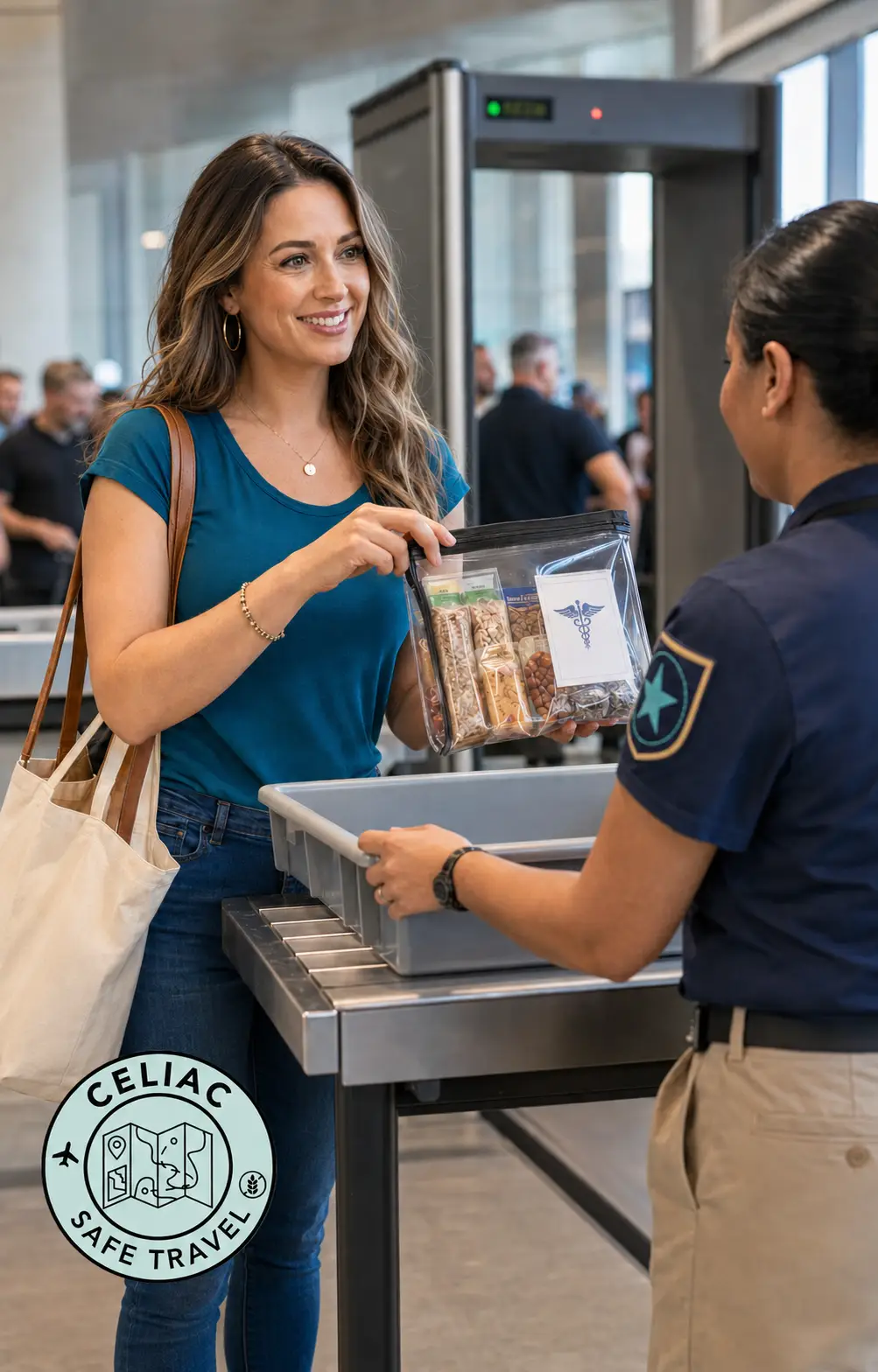
I pack so security barely has to think about it. My gluten-free food goes in a separate clear bag, sealed and obviously store-packaged where I can. A wrapped bar gets a very different reaction than a mystery sandwich in foil.
I lead with the medical piece, calmly. Something as simple as, “I have celiac disease — it’s a medical condition covered under the ADA — and this is my medically necessary gluten-free food.” That’s not picking a fight. It’s handing them the exact words they need to say yes. And like I said, most of the time, that’s all it takes.
I usually carry a note from my provider, too. You don’t legally have to prove anything to bring in safe food, but a short letter saying you have celiac and need a gluten-free diet can end a tense exchange in about four seconds. I think of it like a medication list — a tiny piece of paper that makes life easier.
And if the person at the door says no, I politely ask for a supervisor. Nine times out of ten the issue is that the staffer just doesn’t know their own venue’s policy, and the people who actually set those rules aren’t the ones running the metal detector. The old me would have just gone back to the car. The current me asks one more question.
Here’s a real example that still surprises me. This past March, my daughter and I visited Pearl Harbor, and going in they told us absolutely no food and no bags were allowed inside — you had to lock everything up before entering. My stomach dropped a little, because we’d planned to be there all day. So I went straight to security, told them it was a medical bag and that I have celiac disease, and they let me bring the entire bag through with no issues at all. We ended up spending the whole day there, and I was so glad we had our own safe food with us instead of scrambling and going hungry.
One last thing, and I mean it: be kind. The person searching your bag usually isn’t your enemy — they’re enforcing a rule someone handed them. Warmth plus clear information gets me through the door far more often than attitude ever would.
Bottom line
Celiac disease is a recognized disability, safe food is a medical necessity and not a luxury, and the law expects venues to bend rules like “no outside food” to accommodate that. I still eat before I go sometimes, out of habit as much as anything — but I don’t get sent back to the car anymore, because now I know what to say. So the next time a hand comes out of your bag holding your lunch and hesitates, you can meet that pause knowing you’re on solid ground. Pack your food, know your rights, stay kind, and go enjoy the show.
Educational content only — not legal or individualized medical advice. Venue policies vary and change over time; always confirm accommodation procedures directly with the venue, and talk to your own healthcare provider or a qualified attorney about your specific situation.
Sources & References
- U.S. Department of Justice, Guide to Disability Rights Laws — ADA.gov. Definition of disability, Title III public accommodations, and the requirement to make reasonable modifications to policies, practices, and procedures. https://www.ada.gov/resources/disability-rights-guide/
- Celiac Disease Foundation, Celiac Disease Foundation Publishes First-Ever Evidence-Informed National Recommendations to Support College Students with Celiac Disease (2026) — Confirms celiac disease qualifies as a disability under the ADA and references DOJ settlements with Rider University and Lesley University and litigation involving the University of Maryland. https://celiac.org/…
Join the conversation in our Facebook community · Follow @celiacsafetravel on Instagram